Combs Spouts Off

"It's my opinion and it's very true."

  • Calendar

    November 2026
    S M T W T F S
    1234567
    891011121314
    15161718192021
    22232425262728
    2930  
  • Recent Posts

  • Tag Cloud

  • Archives

Posts Tagged ‘human rights’

Liberal betrayal

Posted by Richard on May 5, 2006

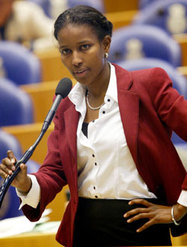
Ayaan Hirsi AliAyaan Hirsi Ali is a remarkable woman. Born in Mogadishu, Somalia, in 1969 and brought up Muslim, she at one time was an Islamic fundamentalist who wanted to become a martyr. In 1992, on her way to Canada for an arranged marriage with a distant cousin, Hirsi Ali went to the Netherlands instead and was granted asylum. She studied political science in the Netherlands, eventually getting a Masters degree. She became active in the Social Democrat party, and today serves in the Dutch Parliament as a member of the center-right (classical liberal) V.V.D. (People’s Party of Freedom and Democracy).

Hirsi Ali is an outspoken critic of radical Islam and especially its treatment of women. She’s been honored numerous times for her work in defense of human rights and Western/Enlightenment values. She wrote the script for the short film Submission, for which director Theo Van Gogh was brutally murdered on an Amsterdam street by an Islamist thug. Her life has been threatened countless times, and she’s under armed guard everywhere she goes.

This past weekend, she was in New York, speaking at the PEN American Center’s "World Voices" event. International PEN bills itself as the world’s oldest human rights organization and defender of free expression, so they should welcome and honor someone like Ayaan Hirsi Ali, right?

Umm, not so much. It seems the New York liberals who run PEN aren’t all that comfortable with someone who passionately defends Western values, reason, and the Enlightenment and who challenges Western leftists’ multiculturalism and tolerance of the intolerant. Pamela at Atlas Shrugs provided portions of Brendan Bernhard’s New York Sun column (paid subscribers only) about her appearance:

Mr. Chernow’s introduction was curiously ungracious. It consisted largely of a warning that the audience might find itself in agreement with only some of what Ms. Ali had to say, or perhaps just a small portion of it, or even none of it. Nevertheless, he assured us, we could all agree that she is a woman of uncommon courage and integrity.

A slender, dark-skinned woman with a pretty face and long-fingered, expressive hands, Ms. Ali, 37, smiled politely as she took this in. She is, after all, a politician, and accustomed to what in a few minutes she would term “the liberal betrayal” — namely, the failure of the West to defend its own Enlightenment values against those who openly seek to undermine or destroy them. On this particular afternoon, it would take an African refugee to remind a New Yorker writer (Mr. Gourevitch), a multi-lingual European intellectual impresario (Mr. Holdengraber), and the president of PEN American Center (Mr. Chernow) that courage and integrity are not necessarily at odds with rational, coherent thought, and might even be an integral part of it. At least Salman Rushdie, seated in the front row in what appeared to be a gesture of moral support for a co-religionist in trouble with Muslim radicals, seemed to understand.
. . .

“My criticism of the West, especially of liberals, is that they do take freedom for granted,” Ms. Ali responded. She noted that Western Europeans born after World War II are unused to conflict. “They have lost the instinct to recognize that there can be such a thing as an enemy or a threat to freedom, and that’s what I’m witnessing in Europe now,” she stated. “[There is] a pacifist ideology that violence should never be used in any circumstances, and so we should talk and talk and talk. Even when your opponent tells you, ‘I don’t want to talk to you, I want to destroy you,’ the reaction is, ‘Please, let’s talk about the fact that you want to destroy me!’”

Reportedly, after Mohammed Bouyeri pulled a gun and shot Theo van Gogh the first time, van Gogh shouted, "We can still talk about it! Don’t do it! Don’t do it!" Bouyeri wasn’t interested in talking; he shot van Gogh a few more times, then slit his throat, and finally stabbed him in the chest.

Ayaan Hirsi Ali understands quite clearly that one can’t reason with or accommodate Islamofascism. One can submit — or die — or fight. She understands that the liberals’ unwillingness to fight — or even to let others fight — for the values they claim to support is a profound betrayal.
 

Posted in Uncategorized | Tagged: , , | 4 Comments »

Aztlan? Tejanos?

Posted by Richard on April 11, 2006

Apparently, most immigration rally organizers realized what a public relations disaster all those Mexican flags last week were. For today’s rallies, the word went out over the Spanish radio and TV stations to carry American flags instead, and in most places they apparently did:

Atlanta police estimated at least 50,000 people joined a two-mile march from a largely immigrant neighborhood Monday morning.

Unlike earlier protests in Los Angeles and other cities when protestors waved flags from Mexico and other countries, activists Monday around the country waved American flags, an obvious response to criticism that illegal immigrants aren’t interested in assimilating into American culture and have no allegiance to this nation.

The obvious exception was LA — a video clip from there showed mostly Mexican flags. The radical group MEChA and the Aztlan movement are powerful in Southern California, and their aim sure ain’t assimilation (see map on left).

MEChA and its allies want to drive out all the gringos (I suppose blacks and Asians are included) and reclaim the southwestern U.S. They dream of some kind of restored Aztec Empire — I don’t know if they’re planning to bring back the blood sacrifices.

In Dallas, by contrast, there was a sea of American flags, and the demonstrators sang "God Bless America!"

But that display of patriotism didn’t stop the Texas Democratic Party from putting their own odd map on their poster (right).

What’s the Spanish word for "pandering"?

(HT: Michelle Malkin via But That’s Just My Opinion.)

Posted in Uncategorized | Tagged: , , | 1 Comment »

Anti-Dhimmi

Posted by Richard on March 24, 2006

I ran across an interesting new blog worth keeping an eye on. Anti-Dhimmi is the work of a 22-year-old female Scandinavian who "got the wake-up call from the Muhammed cartoons folly." It’s a nicely done site with lots of graphics and interesting, short posts.

Regarding Peter Risdon’s announcement that the Danish cartoons aren’t welcome at Saturday’s pro-freedom rally in Trafalger Square, she said:

… And they dare calling it March for Free Expression? How can you have a March for Free Expression without Freedom of Expression? Non sense. Can you say dhimmitude?

 She’s succinct, logical, and doesn’t mince words. I like that. 🙂

UPDATE: Regarding the March for Free Expression and its organizers’ desire to avoid giving offense, see also David T’s post, Compromised, at Harry’s Place, which suggests this as an appropriate chant:

"What do we want: FREEDOM OF SPEECH. When do we want it: NOT NOW BUT CERTAINLY IN A FORUM IN WHICH THINGS CAN BE SEEN AND DEBATED WITHOUT THEM BEING, IN CONTEXT, INTIMIDATING TO ANYONE"

Britain’s leftists are so much more articulate and funny than America’s.

Posted in Uncategorized | Tagged: , , , | 1 Comment »

Condi in Cairo

Posted by Richard on June 24, 2005

Belatedly, I went to the Secretary of State’s site and read the speech Condi Rice delivered at American University in Cairo on Mon., June 20. Wow. It’s a powerful and moving speech, an important speech, and I encourage everyone to read the whole thing. It’s five pages if you print it, which you should do — not only is it easier to read that way, but you can pass it on to others.

But, what the heck, I’ll provide some big chunks of it here. As you read the words, think about what it must have been like to hear it delivered — the electricity and drama of hearing a black American woman address these words to a (predominantly male) audience of Egyptian Arab Muslims. A few years ago, it would have been inconceivable that any American would address an audience in that part of the world with such words. It’s still astonishing and remarkable.

Note: I’m quoting a lot of text. In the interest of readability, I’m dropping the convention of italicizing block quotes (I’ve been thinking of dropping it anyway; if you have thoughts pro or con, let me know).

Rice started by saying as explicitly as I’ve seen it said that American foreign policy throughout the Cold War, post-colonial period was wrong, and that this administration has broken with that shameful past and embraced a principled, idealistic foreign policy as being both more moral and more practical than the cynical "pragmatism" of the past:

In this time of great decision, I have come to Cairo not to talk about the past, but to look to the future — to a future that Egyptians can lead and can define. Ladies and Gentlemen: In our world today, a growing number of men and women are securing their liberty. And as these people gain the power to choose, they are creating democratic governments in order to protect their natural rights.

We should all look to a future when every government respects the will of its citizens — because the ideal of democracy is universal. For 60 years, my country, the United States, pursued stability at the expense of democracy in this region here in the Middle East — and we achieved neither. Now, we are taking a different course. We are supporting the democratic aspirations of all people.

As President Bush said in his Second Inaugural Address: "America will not impose our style of government on the unwilling. Our goal instead is to help others find their own voice, to attain their own freedom, and to make their own way."

We know these advances will not come easily, or all at once. We know that different societies will find forms of democracy that work for them. When we talk about democracy, though, we are referring to governments that protect certain basic rights for all their citizens — among these, the right to speak freely. The right to associate. The right to worship as you wish. The freedom to educate your children — boys and girls. And freedom from the midnight knock of the secret police.

Securing these rights is the hope of every citizen, and the duty of every government. In my own country, the progress of democracy has been long and difficult. And given our history, the United States has no cause for false pride and we have every reason for humility.

After all, America was founded by individuals who knew that all human beings — and the governments they create — are inherently imperfect. And the United States was born half free and half slave. And it was only in my lifetime that my government guaranteed the right to vote for all of its people.

Nevertheless, the principles enshrined in our Constitution enable citizens of conviction to move America closer every day to the ideal of democracy. Here in the Middle East, that same long hopeful process of democratic change is now beginning to unfold. Millions of people are demanding freedom for themselves and democracy for their countries.

She then stepped through a travelogue of the Middle East, providing examples — Jordan, Iraq, the Palestinian territories, Lebanon, Syria, Iran, Saudi Arabia, and ending with Egypt. Some of her descriptions were very positive — justified, IMHO, regarding the Iraqis and Lebanese; overly generous toward Jordan and the Palestinians. But regarding the others, including Egypt, she pulled few punches:

… The case of Syria is especially serious, because as its neighbors embrace democracy and political reform, Syria continues to harbor or directly support groups committed to violence — in Lebanon, and in Israel, and Iraq, and in the Palestinian territories. It is time for Syria to make a strategic choice to join the progress that is going on all around it.

In Iran, people are losing patience with an oppressive regime that denies them their liberty and their rights. The appearance of elections does not mask the organized cruelty of Iran’s theocratic state. The Iranian people, ladies and gentlemen, are capable of liberty. They desire liberty. And they deserve liberty. The time has come for the unelected few to release their grip on the aspirations of the proud people of Iran.

In Saudi Arabia, brave citizens are demanding accountable government. And some good first steps toward openness have been taken with recent municipal elections. Yet many people pay an unfair price for exercising their basic rights. Three individuals in particular are currently imprisoned for peacefully petitioning their government. That should not be a crime in any country.

She made especially specific and detailed remarks about her host country; no pandering here:

Now, here in Cairo, President Mubarak’s decision to amend the country’s constitution and hold multiparty elections is encouraging. President Mubarak has unlocked the door for change. Now, the Egyptian Government must put its faith in its own people. We are all concerned for the future of Egypt’s reforms when peaceful supporters of democracy — men and women — are not free from violence. The day must come when the rule of law replaces emergency decrees — and when the independent judiciary replaces arbitrary justice.

The Egyptian Government must fulfill the promise it has made to its people — and to the entire world — by giving its citizens the freedom to choose. Egypt’s elections, including the Parliamentary elections, must meet objective standards that define every free election.

Opposition groups must be free to assemble, and to participate, and to speak to the media. Voting should occur without violence or intimidation. And international election monitors and observers must have unrestricted access to do their jobs.

Rice then challenged the critics of democracy on a variety of points, including one that we hear all too often from the left (heck, I’ve heard it from Libertarian friends) which just drives me up the wall — the idea that when you prevent someone from oppressing others, you’re "imposing" something on them, denying them their "right" to be an autocrat or tyrant:

Throughout the Middle East, the fear of free choices can no longer justify the denial of liberty. It is time to abandon the excuses that are made to avoid the hard work of democracy. There are those who say that democracy is being imposed. In fact, the opposite is true: Democracy is never imposed. It is tyranny that must be imposed.

People choose democracy freely. And successful reform is always homegrown. Just look around the world today. For the first time in history, more people are citizens of democracies than of any other form of government. This is the result of choice, not of coercion.

There are those who say that democracy leads to chaos, or conflict, or terror. In fact, the opposite is true: Freedom and democracy are the only ideas powerful enough to overcome hatred, and division, and violence. For people of diverse races and religions, the inclusive nature of democracy can lift the fear of difference that some believe is a license to kill. But people of goodwill must choose to embrace the challenge of listening, and debating, and cooperating with one another.

For neighboring countries with turbulent histories, democracy can help to build trust and settle old disputes with dignity. But leaders of vision and character must commit themselves to the difficult work that nurtures the hope of peace. And for all citizens with grievances, democracy can be a path to lasting justice. But the democratic system cannot function if certain groups have one foot in the realm of politics and one foot in the camp of terror.

There are those who say that democracy destroys social institutions and erodes moral standards. In fact, the opposite is true: The success of democracy depends on public character and private virtue. For democracy to thrive, free citizens must work every day to strengthen their families, to care for their neighbors, and to support their communities.

There are those who say that long-term economic and social progress can be achieved without free minds and free markets. In fact, human potential and creativity are only fully released when governments trust their people’s decisions and invest in their people’s future. And the key investment is in those people’s education. Because education — for men and for women — transforms their dreams into reality and enables them to overcome poverty.

There are those who say that democracy is for men alone. In fact, the opposite is true: Half a democracy is not a democracy. As one Muslim woman leader has said, "Society is like a bird. It has two wings. And a bird cannot fly if one wing is broken." Across the Middle East, women are inspiring us all.

Closing: 

Ladies and Gentlemen: Across the Middle East today, millions of citizens are voicing their aspirations for liberty and for democracy. These men and women are expanding boundaries in ways many thought impossible just one year ago.

They are demonstrating that all great moral achievements begin with individuals who do not accept that the reality of today must also be the reality of tomorrow. 

…

… These impatient patriots can be found in Baghdad and Beirut, in Riyadh and in Ramallah, in Amman and in Tehran and right here in Cairo.

Together, they are defining a new standard of justice for our time — a standard that is clear, and powerful, and inspiring: Liberty is the universal longing of every soul, and democracy is the ideal path for every nation.

The day is coming when the promise of a fully free and democratic world, once thought impossible, will also seem inevitable. The people of Egypt should be at the forefront of this great journey, just as you have led this region through the great journeys of the past.

A hopeful future is within the reach of every Egyptian citizen — and every man and woman in the Middle East. The choice is yours to make. But you are not alone. All free nations are your allies. So together, let us choose liberty and democracy — for our nations, for our children, and for our shared future.

Thank you.

Like I said, astonishing and remarkable. Did you notice she used the phrase "ladies and gentlemen" three times? "Woman," "women," "girls," and "daughter" occurred more than a dozen times. There was no pandering to Muslim "cultural sensitivities," no lowered expectations, no showing respect for barbaric values.

I’ve been a bit depressed and annoyed regarding politics lately — the Republicans’ horrible domestic record, their bumbling and timid defense of the war and foreign policy, the ongoing chorus of negativism and cries of "quagmire" (against all realistic assessments from people actually on the scene), the judicial nominations compromise, the Bolton fiasco, the terrible Supreme Court decisions — it’s been just one thing after another.

Reading Condi’s speech reminded me of what’s good about this administration and why I voted Republican for the first time in eight Presidential elections. Reading Condi’s speech made me feel good and hopeful and proud. And filled my eyes with tears.

Thank you, Condi!


Addendum: Ideas have consequences. Two days after her speech:


AMR NABIL / AP

Hundreds of Egyptian activists denounced President Hosni Mubarak’s rule during a rally in Cairo yesterday. Thousands of people lined the streets and watched from windows and balconies.

© 2005 The Seattle Times Company

Posted in Uncategorized | Tagged: , , , , , , , | Leave a Comment »

Democracy, whiskey, Uzbeki?

Posted by Richard on May 14, 2005

Gateway Pundit is your one-stop source for all the news from Uzbekistan. Start with this Friday post. Then this one. Here’s the latest from Saturday. Links galore to sources ranging from the BBC and VOA to Russia’s RIA Novosti and Israel’s Haaretz.

Gateway Pundit recommends checking in with Registan.net for expert analysis and reports from contacts on the ground. Not to mention a plethora of additional links.

The big question, it seems to me, is whether this is primarily a democracy/freedom movement, as in neighboring Kyrgyzstan, or radical Islamism, as President Karimov claims:

TASHKENT, May 14 (RIA Novosti) – The president of Uzbekistan said fierce clashes in Andizhan, a large city in eastern Uzbekistan, had been orchestrated by Hizb ut Tahrir (the Islamic Liberation Party that has branches in many countries). "Those who seized the administration building in Andizhan are members of Hizb ut Tahrir’s local branch, Akramia," president Islam Karimov told a news conference in Tashkent. Karimov said he had held talks with the man leading the group that had seized the administration building, who had declined to give his name.

Muslim Uzbekistan has an interesting Radio Free Europe / Radio Liberty article which quotes some Uzbeki human rights activists to the contrary:

Talib Yoqubov, chairman of the independent Human Rights Society of Uzbekistan, says he believes there is no Akramiya activity in Uzbekistan. Yoqubov told RFE/RL that authorities use charges of Islamic extremism as a pretext for cracking down on dissent.

“They [authorities] made up Akramiya. There is nothing like Akramiya in Uzbekistan now. Several years ago, they spoke of Wahhabi. Then they started talking about Hizb ut-Tahrir. [Membership in] Jamoati Tabligh [another Islamist group] became another accusation under which they imprisoned many people. Now it is Akramiya. I am sure after a while, [the authorities] will come up with some new name. This is the process we witness in Uzbekistan,” Yoqubov said.
… 
However, some rights activists say the Andijan cases may not be only politically but also economically motivated. Uzbek human rights activist Shamsiddinov says the 23 defendants — all wealthy entrepreneurs — established a foundation that was involved in charitable activities. He says the foundation’s assets are the real reason for persecution of its members.

“It’s wrong to name the 23 accused men as extremists and Akramiya members," he said. "They are just a group of entrepreneurs because only few of them are devout Muslims praying and following their faith. …

Nathan at Registan.net suggests caution:

This Forum 18 article gives reason to believe that there isn’t a connection between Akramiya and HT. But, each side definitely has a strong stake in what they are saying, so I advise skepticism of claims from either side.

Hizb ut-Tahrir denies the connection as they usually do. Though I believe that the nature of the unrest is sufficiently economic as to make it almost pointless to talk about what Islamic group is to blame, it’s important to remember that because of the way HT operates, there’s no way that London would know either way if an Uzbek cell was to blame.

One thing’s for sure — the world’s been changing fast since 9/11/01.

Posted in Uncategorized | Tagged: , , , , | 2 Comments »

Condi on gun rights

Posted by Richard on May 14, 2005

Yesterday, Instapundit pointed out this AP story describing Condi Rice’s strong pro-gun remarks in an interview on "Larry King Live":

WASHINGTON – Secretary of State Condoleezza Rice, recalling how her father took up arms to defend fellow blacks from racist whites in the segregated South, said Wednesday the constitutional right of Americans to own guns is as important as their rights to free speech and religion.

Only when Countertop checked the CNN transcript of the show, those remarks weren’t in there. Turns out that CNN didn’t air that part of the interview. Why am I not surprised?

The entire interview transcript is available at the Secretary of State’s site. Go read it all, she makes lots of good points on a broad range of issues. But here’s the section on gun rights (emphasis added):

 MR. KING: By the way, what do you think about gun control?

SECRETARY RICE: Well, Larry, I come out of a — my own personal experiences in which in Birmingham, Alabama, my father and his friends defended our community in 1962 and 1963 against white nightriders by going to the head of the community, the head of the cul-de-sac, and sitting there armed. And so I’m very concerned about any abridgement of the Second Amendment. I’ll tell you that I know that if Bull Connor had had lists of registered weapons, I don’t think my father and his friends would have been sitting at the head of the community defending the community.

MR. KING: So you would not change the Second Amendment? You would not —

SECRETARY RICE: I also don’t think we get to pick and choose in the Constitution. The Second Amendment is as important as the First Amendment of the —

MR. KING: But doesn’t having the guns, while it’s protection, also leads to people killing people?

SECRETARY RICE: Well, obviously, the sources of violence are many and we need to get at the sources of violence. Obviously, I’m very much in favor of things like background checks and, you know, and controlling at gun shows. And there are lots of things we can do. But we have to be very careful when we start abridging rights that our Founding Fathers thought very important. And on this one, I think that they understood that there might be circumstances that people like my father experienced in Birmingham, Alabama, when, in fact, the police weren’t going to protect you.

MR. KING: Did you see him take the guns?

SECRETARY RICE: Oh, absolutely. Every night, he and his friends kind of organized a little brigade.

MR. KING: How old were you?

SECRETARY RICE: I was eight — eight years old.

MR. KING: You remember that?

SECRETARY RICE: I remember it very, very well.

MR. KING: Did you understand it, as an eight-year-old why —

SECRETARY RICE: I understood that something was deeply wrong in Birmingham, Alabama, when I didn’t have a white classmate until we moved to Denver, Colorado. I knew that these were separate societies. Our parents — I grew up in a very nice, sheltered little middle-class community in Birmingham. My mother was a schoolteacher. My father was a minister and a high school guidance counselor. And I’m still friends with a lot of the kids from that community. And we recognize that we had very special circumstances.

Our parents told us, "All right, it may be that you can’t have a hamburger a the Woolworth’s lunch counter, and it may be that you can’t go to this amusement park, Kiddieland, but don’t worry, you can do anything you want. Your horizons should be limitless in America."

MR. KING: Did you believe that?

SECRETARY RICE: And we believed it.

OK, she’s not perfect on the 2nd Amendment (that "controlling at gun shows" remark made me wince). But I think you can count on someone who came to their beliefs on this issue through the experiences she had. And reading that left me teary-eyed.

Condi for President. [Update: Like an idiot, I forgot to add the obvious link at left. Corrected.]

Posted in Uncategorized | Tagged: , , , , , | 1 Comment »