The left’s cause du jour is income inequality, and the Obama administration wants to address it by increasing the national minimum wage by 40% to $10.10 per hour. The Congressional Budget Office predicts that would eliminate 500,000 jobs. Rick Manning noted that to the left that’s not a bug, it’s a feature (emphasis added):
Politically, the left benefits from another half million people off the employment roles as these new government dependents become welfare voters supporting the very politicians whose policies were directly responsible for their job losses.
At the same time, an estimated 16.5 million people are expected to see some increase in their wages. It can be anticipated that a majority of these people will also credit the Democrats for their largesse.
And the kicker is that by including automatic increases tied to the cost of living, these remaining workers will get a raise each year, regardless of whether their employer can afford to provide it. This process ensures additional job losses, accelerating the destruction of gateway jobs in America.
However, none of this matters. For those who benefit politically from government economic dependency, all that matters is that another half million dependency voters will be created with no political downside.
The inherent unfairness to the high school kid going from fast food restaurant to retailer vainly seeking employment doesn’t matter. For many job seekers, the soul-crushing realization that the above-the-table economy has no place for them destroys their connection to the legitimate free-market system. They will place the blame for this failure on our capitalist system rather than the bastardization of that system coming from craven political calculations of leftists in D.C.
Throwing away the hopes and dreams of half a million people is acceptable collateral damage to those who believe the end of achieving a permanent majority of government dependents is worth any means of attaining it.
The idea that mandating a higher starting wage eliminates entry-level jobs, which seems obvious to anyone who understands supply and demand, is disputed by various studies — that is, studies by left-wing academics (often union-funded) who manipulate their methodology to obtain the result they want. Of course, there are other studies with opposite findings — and in fairness, it may be that some of those, too, were manipulated.
The trouble with all such studies is that they invariably compare data either across states with different minimums or across time, before and after a minimum wage increase. Thus they’re comparing minimum wage level A to minimum wage level B. Such comparisons are confounded by factors such as cost of living differences across states or across time, changes in the economy (economic expansion or recession) across time, etc. And a minimum wage mandate has no significant effect if it’s below the market-clearing wage for unskilled, entry-level workers at the time.
Mark J. Perry thought a better comparison would be between places that do mandate a minimum wage and those that don’t. So where do you have to look to find a $0.00 minimum wage — some third-world country? Nope. Western Europe will do.
It turns out that nine Western European nations, including Germany and the Scandinavian countries, have no minimum wage. Their average (mean) and median unemployment rate is about half that of the nine that do mandate a minimum wage (emphasis in original):
Bottom Line: The nine countries in Western Europe with a minimum wage of $0.00 per hour, which most economists and even the New York Times argued in 1987 is the “right” wage, are apparently doing much better economically than the nine countries that have minimum wage laws legislation that makes it unlawful to employ workers whose hourly productivity is below some minimum level arbitrarily dictated by government officials. (Thanks to Don Boudreaux for making that clarification.)
Those concerned about income inequality would do well to focus their attention on the failures of our educational system, as suggested by Nathan Smith in the December 2012 issue of The Freeman (emphasis added):
The State education system is centrally planned and run by committees, so choice and competition are lost from the system. Stagnation is therefore inevitable. Where market forces prevail, productivity improvement is normal. … But productive innovation is difficult and competition is the best school in which to learn it. State education plays hooky from that school, so it fails to learn.
Poor public schools are a major bottleneck holding back the entire U.S. economy. The recent increase in inequality has been driven not by capital but by labor income, as Saez and Piketty stress. This reflects sharply rising demand for certain kinds of skilled, educated workers, combined with little supply response. The public schools and universities are unable and/or unwilling to train the kinds of people the market wants. Eric Brynjolffson argues in his book Race Against the Machine that workers are unable to keep up with new technology. Brynjolffson illustrates his point with the chart shown below:
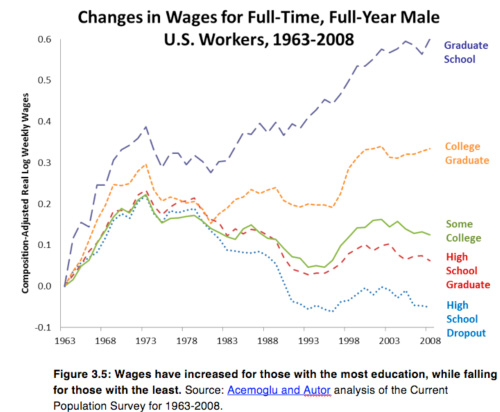
The fact that wages of high school graduates have fallen is a painful remark about how much the market values what the public schools produce. …