


Combs Spouts Off

"It's my opinion and it's very true."

  • Calendar

    December 2025
    S M T W T F S
     123456
    78910111213
    14151617181920
    21222324252627
    28293031  
  • Recent Posts

  • Tag Cloud

  • Archives

Posts Tagged ‘economics’

Obama Spend-o-rama rejected

Posted by Richard on March 21, 2008

Colorado Sen. Wayne Allard, a generally low-profile, unassuming politician, engaged in a marvelous bit of political theater this week. He had his staff start analyzing the 188 spending proposals that Sen. Barack Obama has so far outlined to enact his grandiose agenda. They only got through the first 111, but Allard combined the funding for those and introduced it into the budget debate as Amendment 4246 (PDF).

The 5-year cost of just 60% of Obama's agenda? $1.4 trillion. $300 billion in the first year alone, more than 60% larger than any one-year budget increase ever. How do we pay for such a spend-o-rama? Obama claimed he'd pay for his agenda by letting the Bush tax cuts expire (i.e., everyone's taxes go up) and by raising taxes on "the rich." But the math doesn't add up, as Ross Kaminsky pointed out (emphasis added):

Senator Richard Burr (R-NC), who spoke immediately after Allard, re-emphasized the point: One year of Obama’s proposed spending increase “is bigger than the 5-year increase (in federal income tax collections) that President Clinton imposed on the American taxpayer.”

Burr argued that Obama’s promise to raise taxes just on the Democrats’ “attractive target” of people earning over $250,000, will only generate $225 billion over 5 years, far short of the $1.4 trillion which Obama’s proposed programs (actually only 60% of them) would saddle taxpayers with during that same time frame.

If Obama wanted to raise taxes on only the top 1% (earning over $365,000) to fund his plans, those citizens’ tax bills would have to rise by over $40,000 annually, an increase of 57%. Given the impossibility of that scenario, even under complete Democratic control of government, the tax hikes would have to trickle down to the American middle class.

“So if Congress decides to widen the pool of taxpayers footing the bill, it would have to raise taxes on the top 5% by 38%; or the top 10% by 32%; or the top 25% by 26%; or the top 50% of taxpayers by 23%. The top 50% of American taxpayers, who already pay 96.9% of all federal income taxes, are those who earn $31,000 (AGI) or more.

Obama claims to want to “balance the budget and stop spending the Social Security Surplus.” Combining that laudable goal with Obama’s massive new spending would cause the tax bills of the average taxpayer earning $62,000 to rise $5,300, or 61%. For taxpayers earning $104,000, the increase would be over $12,000, or 74%, and for the top 1%, earning over $365,000, “their income tax bill rise by an astounding $93,500 (132%)!

And remember, that's only to pay for 60% of the Obama agenda announced so far. There's another 40% yet to be analyzed and added to the bill. And it's nearly eight months until the election, so there's plenty of time for more pandering and promises and additional spending proposals.

Allard's "Obama Spend-o-rama" amendment was rejected 97-0 Thursday. But Allard had made his point: the far-far-left agenda of Barack Obama and the massive, unprecedented tax and spending increases they'd require are either unserious, cynical posturing and pandering … or totally insane.
Posted in Uncategorized | Tagged: , , , , , , | Leave a Comment »

Protecting freedom of choice

Posted by Richard on March 8, 2008

Today's Wall Street Journal featured a fine opinion column defending freedom of choice and challenging paternalistic efforts to address three current issues. The author addressed three things in the news lately: subprime mortgages, health insurance, and payday loans. In each case, he argued, efforts to protect people from themselves with more regulation are wrong-headed and counter-productive.

Regarding the "mortgage crisis," the author argued that liberal credit, subprime loans, and adjustable-rate mortgages made home-ownership possible for countless people who otherwise couldn't have achieved it. And for most of them, this was and still is a very good thing: 

According to the national delinquency survey released yesterday, the vast majority of subprime, adjustable-rate mortgages are in good condition,their holders neither delinquent nor in default.

There's no question, however, that delinquency and default rates are far too high. But some of this is due to bad investment decisions by real-estate speculators. These losses are not unlike the risks taken every day in the stock market.

The real question for policy makers is how to protect those worthy borrowers who are struggling, without throwing out a system that works fine for the majority of its users (all of whom have freely chosen to use it). If the tub is more baby than bathwater, we should think twice about dumping everything out.

Regarding health care, the author argued that paternalism has denied people access to affordable options and restricted them to "gold-plated health plans" that they don't want and can't afford:

Buying health insurance on the Internet and across state lines, where less expensive plans may be available, is prohibited by many state insurance commissions. Despite being able to buy car or home insurance with a mouse click, some state governments require their approved plans for purchase or none at all. It's as if states dictated that you had to buy a Mercedes or no car at all.

Regarding payday loans, the author noted that these services, although expensive, allow people of modest means to cope with emergency needs at a far lower cost than the alternatives of bouncing checks or missing payments. The effort to restrict, regulate, or outlaw these services could cause great harm to their supposed victims:

Anguished at the fact that payday lending isn't perfect, some people would outlaw the service entirely, or cap fees at such low levels that no lender will provide the service. Anyone who's familiar with the law of unintended consequences should be able to guess what happens next.

Researchers from the Federal Reserve Bank of New York went one step further and laid the data out: Payday lending bans simply push low-income borrowers into less pleasant options, including increased rates of bankruptcy. Net result: After a lending ban, the consumer has the same amount of debt but fewer ways to manage it.

The "less pleasant options" also include loan sharks with mob connections who break legs when payments are late.

The author concluded with words that made me cheer:

Since leaving office I've written about public policy from a new perspective: outside looking in. I've come to realize that protecting freedom of choice in our everyday lives is essential to maintaining a healthy civil society.

Why do we think we are helping adult consumers by taking away their options? We don't take away cars because we don't like some people speeding. We allow state lotteries despite knowing some people are betting their grocery money. Everyone is exposed to economic risks of some kind. But we don't operate mindlessly in trying to smooth out every theoretical wrinkle in life.

The nature of freedom of choice is that some people will misuse their responsibility and hurt themselves in the process. We should do our best to educate them, but without diminishing choice for everyone else.

If you're reading this on your computer, you're probably already seated. Good. If not, sit down. The author of this wonderful column? George McGovern. Yes, the George McGovern.

Now, listen up, all you doom-and-gloom libertarians and libertarian-conservatives. You whine about how we're losing more and more of our freedoms, about the inexorable growth of Leviathan. You think we're losing the battle for liberty. You speak with contempt about the "sheeple" among whom you live, who are all too eager to "trade their birthright for a mess of pottage." You're wrong. In terms of the intellectual climate, the culture, the prevailing values and beliefs, we've made tremendous progress in the last 40 years.

No, we're not yet on the verge of a libertarian nirvana or a shining city on the hill. But we're not descending into darkness, either. Things have changed, and they've mostly changed for the better.

Except for in a few primitive backwaters and on college campuses, the superiority of "free minds and free markets" is almost universally acknowledged (even if grudgingly, by some). 

And the most radical leftist in my lifetime to be a major-party presidential candidate, the man who in 1972 advocated essentially democratic socialism and a cradle-to-grave welfare state, is today arguing for economic liberty and freedom of choice in a column entitled "Freedom Means Responsibility."

I think that's just way, way cool. Thanks, George! And cheer up, my friends — we're winning the war of ideas, and the future is bright!

(This message brought to you by Denver's most Pollyanna-ish curmudgeon — or curmudgeonly Pollyanna. Something like that. A tip of the hat to Rick Sincere, who had some good comments of his own.) 

Posted in Uncategorized | Tagged: , , , , , | 3 Comments »

Exxon’s obscene taxes

Posted by Richard on February 13, 2008

When Exxon Mobil announced a record $70 billion profit in 2007, every leftist and populist demagogue on the planet screamed in outrage that it was "obscene." But if you're an Exxon shareholder (and almost everyone with a pension plan, 401k, or IRA is, at least indirectly through an equity mutual fund), you might think that it's Exxon's taxes that are obscene. According to Mark J. Perry, Exxon paid $30 billion in taxes in 2007 — a tax rate of more than 40%!

In fact, for the past three years Exxon Mobil's tax bill has averaged over $27 billion a year. And here's the jaw-dropper: according to 2004 IRS data (the latest available), $27 billion is about what the bottom 50% of individual taxpayers pay. Their tax rate, by the way, is about 3% of adjusted gross income. 

Clearly, tax cuts will always "favor" the rich. If by "favor," you mean "bleed less deeply."

Note: The Seeking Alpha article linked above is an expansion of a post from Perry's blog, Carpe Diem. If you're at all interested in economics and business, visit Carpe Diem regularly. Perry is a fount of fascinating facts. Just today, for instance, he honors the death ten years ago of Julian Simon most appropriately

Perry has a knack for simple, striking graphs and charts that drive his point home. For instance, look at yesterday's post showing that we're in the most economically stable period in U.S. history. Or this graphic illustration of what's behind those CEO pay increases. 

UPDATE: This IBD editorial about oil company profits and taxes also noted Perry's numbers and added another interesting stat: 

And it's not just Exxon Mobil that's paying the freight. From 1977 to 2004, according to Tax Foundation data, U.S. oil companies cleared $630 billion after taxes while paying $518 billion in federal and state corporate taxes at an average rate of 45%.

So for the past 27 years, the investors who financed all the exploration, drilling, processing, refining, and distribution (and the concomitant job creation) have had to settle for just over half the profit that their risk-taking created and made possible — and then they had to pay personal income taxes on that.

To the economically illiterate (and the envy-driven), profits are obscene. To me, 40+% taxes are obscene.

UPDATE (10/31/08): The saga continues — Exxon's profits grew to a new record last quarter and its taxes grew even faster. 

Posted in Uncategorized | Tagged: , , | 6 Comments »

Bush soaks the rich

Posted by Richard on December 21, 2007

The Democratic presidential candidates (Edwards especially) have been running around bashing the Bush tax cuts, complaining about "inequality," and promising to make the rich pay their "fair share." But according to The Wall Street Journal, the rich not only pay the vast majority of income taxes, they paid a larger percentage in 2005 than in 2000 (emphasis added):

Last week the Congressional Budget Office joined the IRS in releasing tax numbers for 2005, and part of the news is that the richest 1% paid about 39% of all income taxes that year. The richest 5% paid a tad less than 60%, and the richest 10% paid 70%. These tax shares are all up substantially since 1990, and even somewhat since 2000. Meanwhile, Americans with an income below the median — half of all households — paid a mere 3% of all income taxes in 2005. The richest 1.3 million tax-filers — those Americans with adjusted gross incomes of more than $365,000 in 2005 — paid more income tax than all of the 66 million American tax filers below the median in income. Ten times more.

It wasn't, as the left argues, because of "rising inequality." Between 2000 and 2005, the income share of the richest 1% barely budged, going from 20.8% to 21.2% (a 2% increase). Extrapolating out, that's just 0.8% in a decade. During the 90s, by comparison, the income share of the top 1% rose 7% (from 14% to 21%, a 50% increase). So "rising inequality" was far more in evidence during the Clinton years — when the left didn't seem to notice.  

Notably, however, the share of taxes paid by the top 1% has kept climbing this decade — to 39.4% in 2005, from 37.4% in 2000. The share paid by the top 5% has increased even more rapidly. In other words, despite the tax reductions of 2001 and 2003, the rich saw their share of taxes paid rise at a faster rate than their share of income. 

And contrary to the claims made by the left, the Bush tax cuts didn't increase the deficit, reduce revenue, or need to be "paid for." Lower tax rates (as usual) led to increased tax revenue: 

The amount of capital gains declared on tax forms has doubled since the tax rate was cut to 15% from 20% in 2003, which has also contributed to more Americans being "rich." Dividend income has also increased by at least 50% since that rate was cut to 15% from nearly 40% in 2003. So part of the income gains of the rich are simply a result of assets that have been converted into taxable income — in part because of lower tax rates.

That leads to my main crticism of the Bush tax cuts. I believe it was Milton Friedman who said that if you cut tax rates and revenue increases, it proves that you haven't cut tax rates enough.

Posted in Uncategorized | Tagged: , , | 1 Comment »

This Thanksgiving, celebrate the producers

Posted by Richard on November 22, 2007

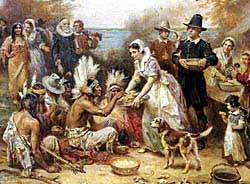
"The first Thanksgiving" by Jean Louis Gerome FerrisUPDATE (Thanksgiving, 2008): Thanks for stopping by. After you read this post and The real Thanksgiving story, don’t miss this year’s funny/sad Thanksgiving story! It’s about kindergarten kids celebrating Thanksgiving. And it features cops and accusations of genocide.
UPDATE (Thanksgiving, 2009): This year, with lots of help from Jim Woods, I again thanked the producers. And remembered the anniversary of the Jihadist attacks on Mumbai. Please check it out.   

Happy Thanksgiving! I hope you have a wonderful day with family, friends, food, and football. But before you leave your PC for the festivities, please read Debi Ghate’s wonderful explanation of what you should be thankful for and who you should thank (bold added, italics in original):

What should we really be celebrating on Thanksgiving?

Ayn Rand described Thanksgiving as “a typically American holiday … its essential, secular meaning is a celebration of successful production. It is a producers’ holiday. The lavish meal is a symbol of the fact that abundant consumption is the result and reward of production.”

She was right. This country was mostly uninhabited and wild when our forefathers began to develop the land and build spectacular cities, shaping what is now the wealthiest nation in the world.

It’s the American spirit to overcome challenges, create great achievements, and enjoy prosperity. We uniquely recognize that production leads to wealth and that we must dedicate ourselves to the pursuit of life, liberty and happiness.

It’s no accident that Americans have a holiday called Thanksgiving — a yearly tradition when we pause to appreciate the “bountiful harvest” we’ve reaped.

What is today’s version of the “bountiful harvest”? It’s the affluence and success we’ve gained. It’s the cars, houses and vacations we enjoy.

It’s the life-saving medicines we rely on, the stock portfolios we build, the beautiful clothes we buy and the safe, clean streets we live on. It’s the good life.

How did we get this “bountiful harvest”? Ask any hard-working American; it sure wasn’t by the “grace of God.” It didn’t grow on a fabled “money tree.”

We created it by working hard, by desiring the best money can buy and by wanting excellence for ourselves and our loved ones. What we don’t create ourselves, we trade value for value with those who have the goods and services we need, such as our stockbrokers, hairdressers and doctors.

We alone are responsible for our wealth. We are the producers and Thanksgiving is our holiday.

So, on Thanksgiving, why don’t we thank ourselves and those producers who make the good life possible?

From a young age, we are bombarded with messages designed to undermine our confident pursuit of values: “Be humble,” “You can’t know what’s good for yourself,” “It’s better to give than receive,” and above all “Don’t be selfish!”

We are scolded not to take more than “our share” — whether it is of corporate profits, electricity or pie. We are taught that altruism — selfless concern for others — is the moral ideal. We are taught to sacrifice for strangers, who have no claim to our hard-earned wealth. We are taught to kneel rather than reach for the sky.

But, morally, one should reach for the sky. One should recognize that the corporate profits, electricity or pie was earned through one’s production — and savor its consumption.

Every decision one makes, from what career to pursue to whom to call a friend, should be guided by what will best advance one’s rational goals, interests and, ultimately, one’s life. One should take pride in being rationally selfish — one’s life and happiness depend on it.

Thanksgiving is the perfect time to recognize what we are truly grateful for, to appreciate and celebrate the fruits of our labor: our wealth, health, relationships and material things — all the values we most selfishly cherish.

We should thank researchers who have made certain cancers beatable, gourmet chefs at our favorite restaurants, authors whose books made us rethink our lives, financiers who developed revolutionary investment strategies and entrepreneurs who created fabulous online stores.

We should thank ourselves and those individuals who make our lives more comfortable and enjoyable — those who help us live the much-coveted American dream.

As you sit down to your sumptuous Thanksgiving dinner served on your best china, think of all the talented individuals whose innovation and inventiveness made possible the products you are enjoying. Debi Ghate

As you look around at who you’ve chosen to spend your day with — those you’ve chosen to love — thank yourself for everything you have done to make this moment possible.

It’s a time to selfishly and proudly say: “I earned this.”

Debi Ghate is Vice-President of Academic Programs at the Ayn Rand Institute in Irvine, California.

Amen.

As for the Thanksgiving lesson to be learned from the history of the Plymouth colony, it’s an economics lesson. I provided a pretty good account (if I do say so myself) last year, with plenty of quotes from Governor William Bradford’s Of Plimoth Plantation. John Stossel wrote a shorter summary of the same lesson this year, which I encourage you to read, too. Even though mine’s better. 🙂

Enjoy your Thanksgiving dinner. And remember to thank the producers who made it possible — including yourself!

Posted in Uncategorized | Tagged: , , , , , | 4 Comments »

China in perspective

Posted by Richard on August 15, 2007

Nicholas Vardy had an interesting "Fact of the Week" in the latest issue of The Global Guru:

The next time you hear a mind-numbing statistic about China, remember this: the U.S. economy increased in size by $2.2 trillion between June 2003 and May 2006. That's the equivalent of a whole new China in just 36 short months.

And we did it without using lead paint. 

Posted in Uncategorized | Tagged: , , , | Leave a Comment »

Tangerine dream

Posted by Richard on July 24, 2007

This is so breathtakingly stupid, it sounds like a parody from Scrappleface or Iowahawk, but apparently it's for real. Yesterday, Ben Smith at Politico.com posted this news from the Edwards campaign:

The politics of global warming got very concrete, and oddly difficult, in a meeting with local environmentalists in the coastal town of McClellanville today, where Elizabeth Edwards raised in passing the importance of relying on locally-grown fruit.

"We've been moving back to 'buy local,'" Mrs. Edwards said, outlining a trade policy that "acknowledges the carbon footprint" of transporting fruit.

"I live in North Carolina. I'll probably never eat a tangerine again," she said, speaking of a time when the fruit is reaches the price that it "needs" to be.

The Bullwinkle Blog commented:

If … enough people are silly enough to follow her example then a lot of tangerine trees will be chopped down and burned to make room for some crop that will make money so the farmer can feed his family. That's sure to release even more Co2 into the fragile atmosphere!

Won't it also mean that the people who earn their livings transporting fruit will lose their jobs and add to the number of Americans living below the poverty line?

Heck, that's not the half of it. If Elizabeth Edwards shuns fruit that isn't grown locally, what about other foods? What about manufactured goods? In North Carolina, locally-produced lumber, paper, and furniture may be easy to come by, but what about clothing, consumer electronics, refrigerators, toilets, cars, DVDs, private jets, …?

Is Edwards advocating autarky at the state level (it's a long truck ride from the Outer Banks to Asheville), the county level, or for every village and hamlet (big cities would likely cease to exist in Edwards' tangerine dream world)?

The world this lunatic envisions is the pre-modern world. That would fulfill the enviro-wackos' goal of minimizing the human impact on the planet — by getting rid of 80-90% of the humans and condemning most of the rest to peasant status. Then we really would have "two Americas."

I'm probably over-reacting. I'm sure she hasn't thought this through and isn't serious — it's just the typical empty gesture that liberals indulge in to feel good about themselves.

And if Mrs. Edwards gets a yearning for some tangerines, she can go with the moose's suggestion of tangerine offsets.  


Posted in Uncategorized | Tagged: , , , , | Leave a Comment »

Cost of Government Day

Posted by Richard on July 12, 2007

Remember Tax Freedom Day? According to the Tax Foundation, if you're quintessentially average, on April 30 you finally finished paying your tax burden for the year and started to work for yourself instead of the government. Hooray, right?

Not so fast, bubba. Americans for Tax Reform thinks the Tax Foundation overlooked a big chunk of change — the cost of government regulation. So ATR calculated the total cost of government and when you, the average wage slave, have finally earned enough to pay your share. And they determined that July 11 is Cost of Government Day.

Congratulations. From here on — for the remaining 47.4% of the year — you're paying for your own Cheetos and beer instead of someone else's. Rick Sincere has the whole story, including how much worse the situation has become in the past century.

Posted in Uncategorized | Tagged: , , , , | Leave a Comment »

How Edwards fights poverty and predatory lenders

Posted by Richard on May 12, 2007

John Edwards' campaign is once again all about deploring the "two Americas" (AKA, exploiting envy, inciting class warfare, and bashing the rich). So, it's been mildly amusing to read about his 28,000-square-foot house, $400 haircuts, and generally ostentatious lifestyle. It got even funnier when he explained that he worked for Fortress Investment Group, a $30-billion hedge fund catering to billionaires, to learn more about poverty.

But here's what dialed the irony, chutzpah, and hypocrisy meters up to about 11: In early April, Edwards declared war on those evil lenders who specialize in "subprime loans and predatory mortgages" (emphasis added): 

As part of his ongoing effort to expand and strengthen the middle class, Senator John Edwards today released an aggressive plan to end the harmful lending practices that have put millions of families at risk of losing their homes. At a town hall in Davenport, Iowa, Edwards called for strong national legislation to regulate mortgage abuses and prohibit predatory mortgages. He also proposed immediate steps, including bankruptcy reforms and the creation of a Home Rescue Fund, to provide relief for families who are struggling to keep their homes.

"This is about the future of the middle class," said Edwards. "While Washington turns a blind eye, irresponsible lenders are pulling a fast one on hard-working homeowners. Using deceptive practices, hidden fees, and abusive terms, they have already taken billions of dollars from hard-working homeowners, destroying their nest eggs in the process. For too many families, homeownership has become a risky gamble when it should be the foundation of economic security. It's time to put an end to the shameful lending practices that are compromising our strength as a nation." 

Well, it turns out that his former employer, Fortress, is one of those "irresponsible lenders," and greatly expanded its role in the subprime market while he was there advising them: 

The hedge fund that employed John Edwards markedly expanded its subprime lending business while he worked there, becoming a major player in the high-risk mortgage sector Edwards has pilloried in his presidential campaign.

Edwards said yesterday that he was unaware of the push by the firm, Fortress Investment Group, into subprime lending and that he wishes he had asked more questions before taking the job. The former senator from North Carolina said he had asked Fortress officials whether it was involved in predatory lending practices before taking the job in 2005 and was assured it was not.

Of course he was. 

Fortress, whose hedge funds are incorporated in the Cayman Islands to get the kind of tax breaks Edwards routinely rails against, is a not-insignificant player in funding his campaign:

Fortress announced Edwards's hiring as an adviser in a brief statement in October 2005. Neither Edwards — who ended his consulting deal when he launched his presidential campaign in December — nor the firm will say how much he earned or what he did.

But his ties to Fortress were suggested by the first round of campaign finance reports released last week. They showed that Edwards raised $167,460 in donations from Fortress employees for his 2008 presidential campaign, his largest source of support from a single company.

Edwards, who was described as a "senior adviser" at Fortress, now insists that he had no idea Fortress was gobbling up subprime mortgages and lenders, and that he really didn't spend much time at the Fortress offices. I can think of two possibilities:

  1. This was a sham job designed to give Fortress a big name on its letterhead and Edwards a valuable "private sector experience" entry on his resume.
  2. Edwards is lying. 

Explanation 1 represents a fairly common practice in certain circles and is thus likely to be true. But given the fact that he's a trial lawyer who got rich by channeling dead fetuses to gullible jurors, I'm leaning toward number 2.

The real irony, from my perspective, is that if he weren't so committed to his anti-capitalist demagoguery, Edwards could justifiably say that, while he regrets certain excesses, on the whole he's proud of what he and Fortress have done for middle and lower income Americans, especially minorities.

New financing tools and easier credit have generally been a big success. Homeownership is at record levels. Sure, foreclosures are up and some lenders clearly went too far with the "creative" financing, but the vast majority of subprime borrowers are not losing their homes — they're making their payments, building equity, and proud to be part of the property-owning class.

But there's simply no pleasing the left. Twenty years ago, liberals complained that it was too difficult for minorities and working-class people to qualify for a mortgage. Now, they're complaining that it's too easy.

Posted in Uncategorized | Tagged: , , , | Leave a Comment »

Tax Freedom Day

Posted by Richard on April 30, 2007

Happy Tax Freedom Day! If you have an average income and live in an average state, today is the day you start working for yourself instead of the government. All the income you earned from January 1 until now went to pay your share of total tax collections:

"Tax freedom will come two days later in 2007 than it did in 2006," said Tax Foundation President Scott A. Hodge, "and fully 12 days later than in 2003, when tax cuts caused Tax Freedom Day to arrive comparatively early, on April 18."

However, 2007's Tax Freedom Day is still slightly [e]arlier than it was in 2000, when the economic boom, the tech bubble and higher tax rates pushed tax burdens to a record high, and Tax Freedom Day was postponed until May 5.

Of course, Tax Freedom Day is based on averages:

Tax Freedom Day answers the basic question, "What price is the nation paying for government?" We divide the most authoritative figure for total tax collections by the most authoritative figure for the nation's income. The answer this year is that taxes will amount to 32.7 percent of our income. We convert that percentage into days worked, and if we started on January 1, it would take until April 30. That's when we could start keeping some of our earnings. Income and tax data are then parsed out to the states, yielding 50 state-specific Tax Freedom Days

The state Tax Freedom Days range from Oklahoma's April 12 to Connecticut's May 20. Colorado's was April 28. Tennessee did significantly better with April 15.

These minor state-by-state variations, however, are dwarfed by the greater variability based on your income. Contrary to the class-warfare rhetoric of John Edwards and other socialists masquerading as Democrats, the rich are already getting soaked. Heck, the moderately well-off are getting soaked. According to the National Taxpayers Union, the top 10% of income earners paid over two-thirds of all federal personal income taxes in 2004, while the bottom half paid barely over 3%. Here are the numbers:

For Tax Year 2004

Percentiles Ranked by AGI

AGI Threshold on Percentiles

Percentage of Federal Personal Income Tax Paid

Top 1%

$328,049

36.89

Top 5%

$137,056

57.13

Top 10%

$99,112

68.19

Top 25%

$60,041

84.86

Top 50%

$30,122

96.70

Bottom 50%

<$30,122

3.30

Note: AGI is Adjusted Gross Income
Source: Internal Revenue Service


So if you're making $60k or better — not exactly rolling in dough — you're going to be working for the government for a while longer. And if you're at $100k — well off, but not quite filthy rich — well, you'd better keep that nose to the grindstone, because Congress has lots more earmarks to pay for. 

Posted in Uncategorized | Tagged: , , | Leave a Comment »

Must-see HDTV

Posted by Richard on April 25, 2007

Did you take my advice and watch "The Ultimate Resource" last night? It was simply outstanding, meeting and exceeding my rather high expectations. Visually, it was first-class — beautiful high-definition video comparable in quality to the better Discovery HD programming. The content was fascinating as well as uplifting.

My only minor criticism is that the last of the five segments — the story of Shanghai entrepreneurs and their computer game company — was the weakest. The China segment was merely interesting, while the preceding four segments were moving:

  • In Ghana, a poor fisherman and his wife wanted their daughter to get a good education, so they put her in a private school instead of the free government school. James Tooley explained that in this very poor region of Ghana, 75% of the schools are private and for-profit, and all of them outperform the government schools.
  • In Peru, remote mountain villagers celebrated when they finally get legal titles to land that their families have worked for generations. Hernando de Soto talked about how property rights and the rule of law can turn the world's four billion poor into eager and successful stakeholders in the capitalist system.
  • In Estonia, the former Soviet republic has become one of the economically freest countries on Earth, enabling the Estonia Piano Company to transform itself from an inefficient producer of mediocre pianos for the state into an efficient, successful producer of some of the world's highest-quality instruments.
  • In Bangladesh, a young woman got a small loan so she and her husband could buy a loom. This enabled them to make and sell high-quality saris, lifting themselves out of poverty. Nobel Peace Prize winner Muhammed Yunus and his Grameen Bank have made millions of similar "microcredit" loans (averaging $70), always for an income-producing purpose that will lift a family out of poverty. The repayment rate is 99%. 

The program is a joyous and heartwarming celebration of the human spirit and of the benefits of liberty. By all means, see it if you can. HDNet is showing it several more times in the next few days (see schedule). I'm sure it will eventually be available on DVD, but if you can see it on HDNet this week, I bet you'll be glad you did. 

Posted in Uncategorized | Tagged: , , , , , , , , , , | Leave a Comment »

The Ultimate Resource

Posted by Richard on April 23, 2007

If you're an advocate of free markets and a fan of the late Julian Simon and the late Milton Friedman, and you have an HDTV, it doesn't get any better than this: glorious high-definition images from exotic locales all over the world celebrating people's creativity as the ultimate resource and freedom as the key to enabling them to accomplish wonderful things. 

Tuesday, April 24, at 10 PM Eastern, HDNet premieres a new documentary from Free To Choose Media entitled "The Ultimate Resource." It will repeat five more times between then and May 5 (see schedule), so you have time to buy that high-def TV you've been thinking about and order HD programming from your cable or satellite provider. 

Lance at A Second Hand Conjecture has lots of info:

In short, they travel to China, Bangladesh, Estonia, Ghana, and Peru and show examples of how people (thank you Julian Simon) – when given the incentives and the tools – are proving they can apply their free choice, intelligence, imagination and spirit to dramatically advance their well-being and that of their families and communities. …

You can see the trailer and more here. Teachers can get the video (and lots of other resources) for free at izzit.org.

These stories of entrepreneurship and achievement among the world's poorest people illustrate the ideas of four outstanding thinkers featured in the program:

Muhammad Yunus, winner of the 2006 Nobel Peace Prize, founded the Grameen Bank in Bangladesh, which uses microfinance to bring opportunity to the world’s poorest people by helping them to start their own businesses.

Hernando de Soto, founder of The Institute for Liberty and Democracy in Peru, helps developing countries open their systems — creating strategies for legal reform that offer the majority of the world’s people a stake in the free market economy.

James Tooley, British professor of education policy, explores the widespread, dramatic impact of low budget private education– financed not by charities or wealthy supporters– but by the poor families themselves in India, China, Nigeria, Kenya and Ghana.

Johan Norberg, Swedish author and scholar, takes aim at both left-wing critics, who would condemn developing countries to poverty until they develop “First World” workplace standards, and Western governments, whose free market rhetoric is undercut by tariffs on textiles and agriculture, areas in which developing countries can actually compete.

Wow, what a lineup! I can't wait to see it. 

Posted in Uncategorized | Tagged: , , , , , , , , , , | Leave a Comment »

Econ 101 and Iran

Posted by Richard on March 22, 2007

The Watcher of Weasels chose Big Lizards to fill the last vacancy on the Watcher's Council, and it looks like a fine choice. Check out, for example, The Contranomics of Global Jihad, nominated by the Council as one of this week's most link-worthy pieces of writing. Dafydd's excellent post argues that Iran is in the process of being defeated in the same way that the Soviet Union was defeated — by economics, not military force (emphasis in original):

Force projection is dreadfully expensive, even if you call it global jihadism: Iran is supporting Hezbollah in Syria and Lebanon, the Qods Force in Iraq, a war against Israel a few months ago, assassins all over the world, and Shiite revolutionary movements from Malaysia to Venezuela. But at the same time, the drain on their resources from trying to develop a nuclear "Qods bomb" and buy a delivery system from North Korea, Russia, or Red China has caused Iran to stop investing in its oil infrastructure.

Totalitarian, anti-capitalist societies, Dafydd points out, simply can't afford the technological development and force projection that Iran is trying to pursue. Only free, open societies that grasp Econ 101 can do that.

Read the whole thing. And browse some of his other stuff, too — it's a good blog, once you get past the blinding banner!

Posted in Uncategorized | Tagged: , , , , | Leave a Comment »

Insurance scam

Posted by Richard on February 20, 2007

I’m no insurance expert, but I know that flood insurance is a special case. Some time back, the feds effectively preempted the field, and if you want flood insurance, you get it at a federally subsidized rate. Because of that situation, no ordinary property insurance policy covers flood-water damage. You’d think people who live in a highly flood-prone area, such as a Gulf Coast state subject to hurricanes, would know this and gratefully avail themselves of the subsidized, low-cost flood insurance, right? And you’d think those who didn’t bother could expect little sympathy from the courts and public officials, right?

Wrong. And wrong again. In Mississippi, the courts and Attorney General Jim Hood have fallen all over themselves with sympathy for the (voluntarily) uninsured victims of Katrina’s flood waters. As a consequence of some jury awards and coerced settlements negotiated with the AG, State Farm has decided the climate in Mississippi is so hostile that they can’t continue offering homeowner insurance in the state. The future risk is too great.

Attorney General Hood objected to this business decision, and he’s proposed a law to force insurance companies who sell auto insurance in the state to also sell homeowner insurance. Dan Melson took umbrage at this anti-capitalist move:

State Farm is not a charitable organization. They are entitled to charge enough to make a profit – otherwise there is no reason to be in business. If they decide they cannot do that within the environment in a given state, they are entitled to decide to leave. If they can’t do it at all, the correct decision is to go out of business.

Add hefty punitive fines for not wanting to pay out claims for things which weren’t insured, and it’s a miracle that anyone is willing to issue homeowner’s insurance in Mississippi. Make them write homeowner’s insurance in order to write automobile insurance, and some insurers might do it – but others will cancel their policies of automobile insurance. Exactly how bad does the state of Mississippi want their insurance situation to get?

Dan’s right, of course. Hood’s populist grandstanding is both immoral and stupid. The state’s deputy insurance commissioner noted that a similar, but less onerous, law in Florida is driving insurers out of the state already, even though it won’t take effect until 2008. Robert Hartwig, chief economist for the Insurance Institute, doesn’t think such a law will have the desired effect:

Automobile insurance isn’t profitable enough to offset losses in the sale of homeowner insurance in a hurricane-vulnerable region so the company may be inclined to stop selling auto policies if they also must sell homeowner policies there, Hartwig said.

"The only losers in this situation are consumers facing fewer options for automobile insurance," Hartwig said.

I’m pleasantly surprised that Republican Governor Haley Barbour, despite an upcoming re-election campaign, resisted the urge to pander or cave and rejected Democrat Jim Hood’s call for an executive order:

"Having considered my statutory and constitutional emergency powers including the statute you cited in your letter, I have no authority to force a private company to sell its products in the State of Mississippi," Barbour responded in a letter to Hood.

After the epidemic of invertebrateness among Republicans recently, that statement — as cautious as it is — is a breath of fresh air. Bravo, Gov. Barbour!
 

Posted in Uncategorized | Tagged: , , , , , | 7 Comments »

Happy Milton Friedman Day!

Posted by Richard on January 29, 2007

Today is Milton Friedman Day — "a celebration of the economist’s positive impact on American life and business, and the spread of the benefits of free markets to nations around the globe." Friedman, who died on November 16 at the age of 94, is considered one of the — if not the — most influential economists of the 20th century. To honor his memory, the University of Chicago is holding a memorial service today at 2 PM Eastern. Speakers include Czech President Vaclav Klaus. As I write this, the live webcast should be starting in a few minutes. You can also watch it, along with the entire Free to Choose TV series and other Friedman video, at ideachannel.tv.

Later tonight, don’t miss a new PBS special on Friedman from Free to Choose Media, The Power of Choice. Here in Denver, it’s on KRMA-6 at 9 PM. Check your local PBS affiliate’s listings.
 

Posted in Uncategorized | Tagged: , , , , | Leave a Comment »